Dark Matter, Gravitational Lensing, and Cosmic Neutrinos: The Universe Gets Weird (and Wonderful)
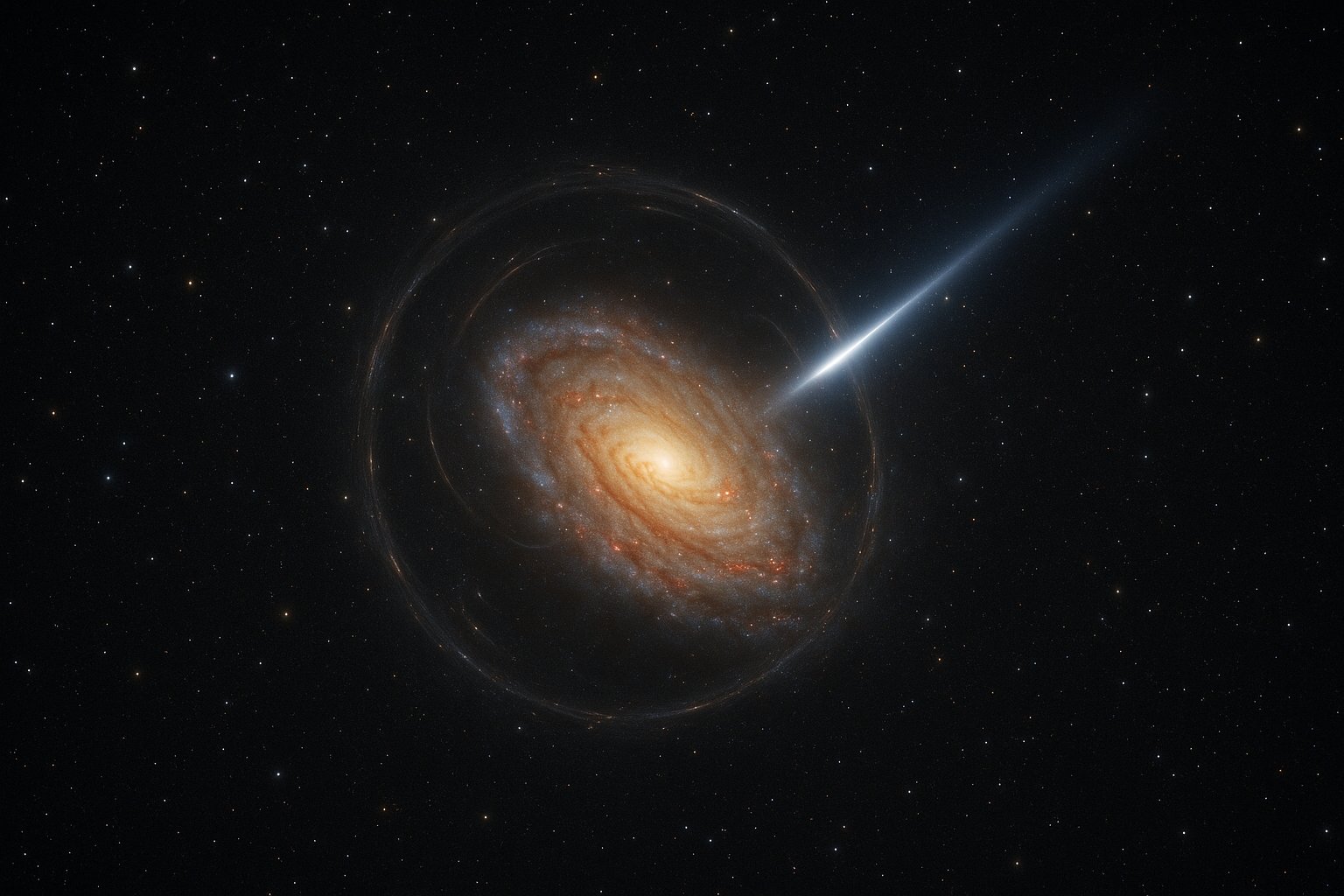
If you love mysteries with cosmic stakes, this week’s astronomy news delivers: For the first time, scientists have caught an unseen bundle of dark matter gravitationally lensing the jet of a distant blazar—a galaxy with a supermassive black hole and a penchant for spewing out cosmic particles. Even more mind-bending? This blazar is a likely source of cosmic neutrinos, the near-massless, barely-there particles that fly through you (and the rest of Earth) by the trillions every second. Read the full discovery here. Welcome to astrophysics where seeing the invisible is the name of the game.
What Is Gravitational Lensing—and Why Does Dark Matter Matter?
Imagine looking through a cosmic magnifying glass, but the glass isn’t made of anything we can see—it’s literally invisible. That’s gravitational lensing: When a huge mass (like a cluster of dark matter) bends the fabric of spacetime, it warps and magnifies light from distant objects behind it. It’s like watching a streetlamp waver through a glass of water, except the glass is made of… well, who knows?
Dark matter is the universe’s ultimate whodunit—accounting for about 85% of the universe’s matter, but refusing to interact with light. We can’t see it, but we can see what it does. And this week, astronomers led by Silke Britzen at the Max Planck Institute have traced the distortion of a blazar’s jet not to a visible galaxy, but to an invisible, dark matter lens. The blazar, by the way, is likely popping out cosmic neutrinos—ghostly particles that travel vast distances and help us understand the most energetic processes in the universe.
Why Neutrinos? Why Now?
Neutrinos are the universe’s ultimate introverts: They rarely interact with anything, making them both a pain and a prize to astrophysicists. When we trace a neutrino back to its source, we’re essentially peeking behind the cosmic curtain—getting a front-row seat to black holes, neutron stars, and the high-energy fireworks of the universe.
This new gravitational lensing effect means we can not only spot distant sources of neutrinos more easily, but also learn about the dark matter that’s warping their signals. It’s a cosmic two-for-one: Find the lens, find the particle source, and get a bonus lesson in the structure of the invisible universe.
How Students and Early-Career Researchers Can Get Involved
Astrophysics is booming with big questions and (let’s be honest) big data. Whether you’re aiming to study dark matter, gravitational lensing, or cosmic neutrinos, there’s a galaxy of opportunities—IF you know where to look. Here’s how you can jump into the action:
- Find funding for your cosmic ambitions: Use Seamless’s Scholarship Search and Research Grants tools to match with STEM scholarships and astrophysics research grants worldwide.
- Survey the state of the universe: The Literature Review tool pulls together the latest research (and identifies gaps) on topics like gravitational lensing, dark matter, and neutrino astronomy—so you can find your own niche.
- Pitch your findings: Turn your literature review or research proposal into a shareable, narrated podcast with the AI Podcast Generator (great for explaining your science to friends, family, or your future Nobel audience).
Sample Astrophysics Research Topics to Explore
If this latest discovery has you starry-eyed, here are a few hot research areas you could tackle as a student, intern, or early-career researcher:
- Statistical mapping of dark matter via gravitational lensing in galaxy clusters
- Identifying cosmic neutrino sources using multi-messenger astronomy (combining neutrino and electromagnetic signals)
- Machine learning for gravitational lens detection in telescope survey data
- Simulation of jet emission from blazars and their interaction with cosmic structures
No telescope in your backyard? No problem! Many of these projects use open datasets or remote access to observatory data—perfect for students worldwide.
How to Launch Your Own Cosmic Quest (and Actually Get Funding)
Let’s be real: Science is awesome, but rent exists. If you want to actually do research (not just dream about it), you need funding—and it’s out there, if you know where to look:
- Undergraduate and graduate astrophysics scholarships are available globally; many support research on dark matter, neutrinos, and cosmology.
- Early-career research grants often fund international collaborations, travel to observatories, or computing resources for data analysis.
- Summer schools and workshops in astroparticle physics and cosmology can jump-start your network and skills.
Start with Seamless’s Scholarship Search and Research Grants to map your options—and use the Application Helper to stay on top of deadlines, requirements, and (inevitably) recommendation requests.
From Science News to Your Next Research Adventure
This week’s discovery isn’t just another space headline—it’s a fresh clue in the grand cosmic puzzle. If the invisible architecture of the universe, the chase for elusive neutrinos, and the wild world of gravitational lensing excite you, now is the moment to get involved. Whether you start by reviewing the literature, pitching a research idea, or creating a podcast explaining gravitational lensing to your classmates, Seamless has tools to launch your journey:
- Discover scholarships and grants in astrophysics and cosmology
- Create a targeted literature review on gravitational lensing or dark matter
- Turn your review into a podcast—and inspire others to join the cosmic quest
Ready to trace the universe’s deepest mysteries? Start your research journey—and maybe spot the next cosmic phenomenon—using Seamless’s suite of tools. Let’s make invisible matter a little less mysterious, together.