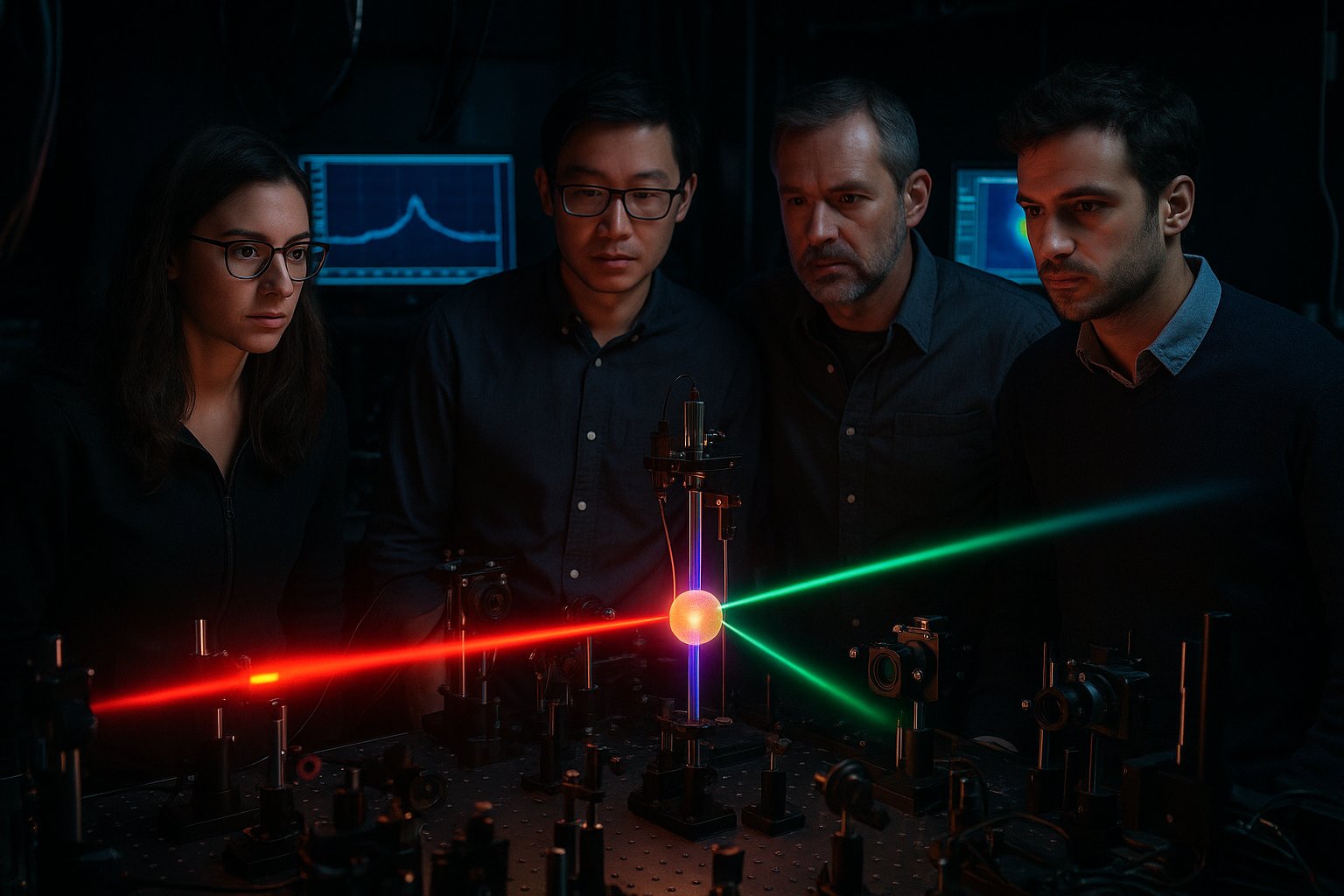
Ultracold cesium atoms have just done what many quantum physicists only dreamed of: they’ve made the nearly century-old prediction of Bethe strings visible in the real world. If you’re even remotely quantum-curious (and let’s be honest, who isn’t at least a little?), this discovery is a big deal. Not only does it unlock new insights into 1D quantum systems, but it’s also a prime example of how deep theory, experiment, and modern technology can team up to unlock the universe’s hidden rules.
What Are Bethe Strings—And Why Should You Care?
Back in 1931, Hans Bethe (yes, that Bethe, of Bethe ansatz fame) predicted that in certain one-dimensional quantum systems, particles—like the atoms in an ultracold gas—can form exotic bound states called “Bethe strings.” Imagine several particles, usually content to do their own thing, suddenly holding hands and moving as one, all thanks to the weirdness of quantum mechanics.
These strings have evaded direct observation for nearly a century. But now, thanks to experimental physicists cooling cesium atoms to a fraction of a degree above absolute zero, they’ve finally shown up—right where Bethe said they’d be. Cue the quantum confetti!
The Experimental Breakthrough: Quantum Theory Meets Reality
Why is this result so exciting? Because it validates some of the boldest ideas in condensed matter physics and quantum mechanics. Ultracold atomic gases are like playgrounds for quantum phenomena: by tweaking the temperature, magnetic fields, and even the shape of the “trap” holding the atoms, researchers can create nearly textbook-perfect quantum systems.
In this experiment, cesium atoms were cooled and arranged in a one-dimensional lattice. Researchers then observed energy states that matched the theoretical predictions for Bethe strings—multi-particle states that were previously just lines in a textbook. Suddenly, the quantum world got a whole lot more tangible.
How Can This Help STEM Students & Early-Career Researchers?
You don’t need your own cold-atom lab to get in on the action. This breakthrough is a gold mine for research, essays, and even grant proposals. Here’s how you can leverage it:
- Explore the Literature Review tool to map the research landscape surrounding Bethe strings, ultracold atoms, and quantum simulations—all with a smart gap analysis to find fresh questions no one’s tackled yet.
- Turn your review into a AI Podcast or even a Video Podcast—perfect for class presentations, science clubs, or outreach projects. Seamless makes it easy to generate narrated or lip-synced video explainers from your research.
- Looking to launch your own quantum project? Use the Scholarship Search and Research Grants tools to find funding opportunities for quantum physics, condensed matter, or experimental physics research—no matter your level.
Why Are Bethe Strings So Important for Quantum Science?
Bethe strings aren’t just theoretical bling for quantum nerds. Their observation could:
- Advance our understanding of many-body quantum physics
- Enable new approaches in quantum simulation and quantum computing
- Offer insights into real-world materials, possibly leading to novel quantum devices or better superconductors
It’s also a reminder that theory and experiment can, eventually, meet in the middle—even if it takes 95 years and some fancy cryogenics.
Scannable Takeaways for STEM Students
- Quantum phenomena like Bethe strings are now observable—opening new research avenues.
- You can use Seamless tools to review, present, and get funded for quantum research.
- This topic is great essay or grant fodder—impress your professors or proposal reviewers with a timely, cutting-edge subject!
From Literature Review to Funding: Your Seamless Quantum Toolkit
Ready to leap into the quantum realm? Here’s a quick cheat sheet:
- Start with the science: Use Seamless’s Literature Review for a deep dive into ultracold atom experiments and Bethe string theory.
- Get your ideas out there: Spin up an AI-powered podcast or video podcast to make quantum concepts accessible and memorable (bonus: looks amazing in your portfolio or application).
- Find your funding: Seamless’s Scholarship Search and Research Grants tools match you to quantum-friendly awards and opportunities.
Next Steps: Quantum Is Waiting (and So Are the Scholarships)
Curious to dig deeper? Read the original news story for all the experimental details, then put theory into practice with Seamless. Whether you’re prepping for grad school, working on an honors thesis, or just quantum-obsessed, Seamless can help you find the latest research, funding opportunities, and ways to communicate your results, all in one place.
Ready to launch your own quantum journey? Find scholarships, review the literature, and transform your research into AI-powered podcasts with Seamless—no quantum computer required.