Original source: sciencedaily.com — A material just one atom thick reveals a strange quantum secret
A team at the University of Osaka has directly observed unusual quantum states—called heavy fermion states—forming at the interface between a material just one atom thick and a metal. According to sciencedaily.com, this finding could pave the way for new quantum materials with properties not seen in conventional substances.
What happened
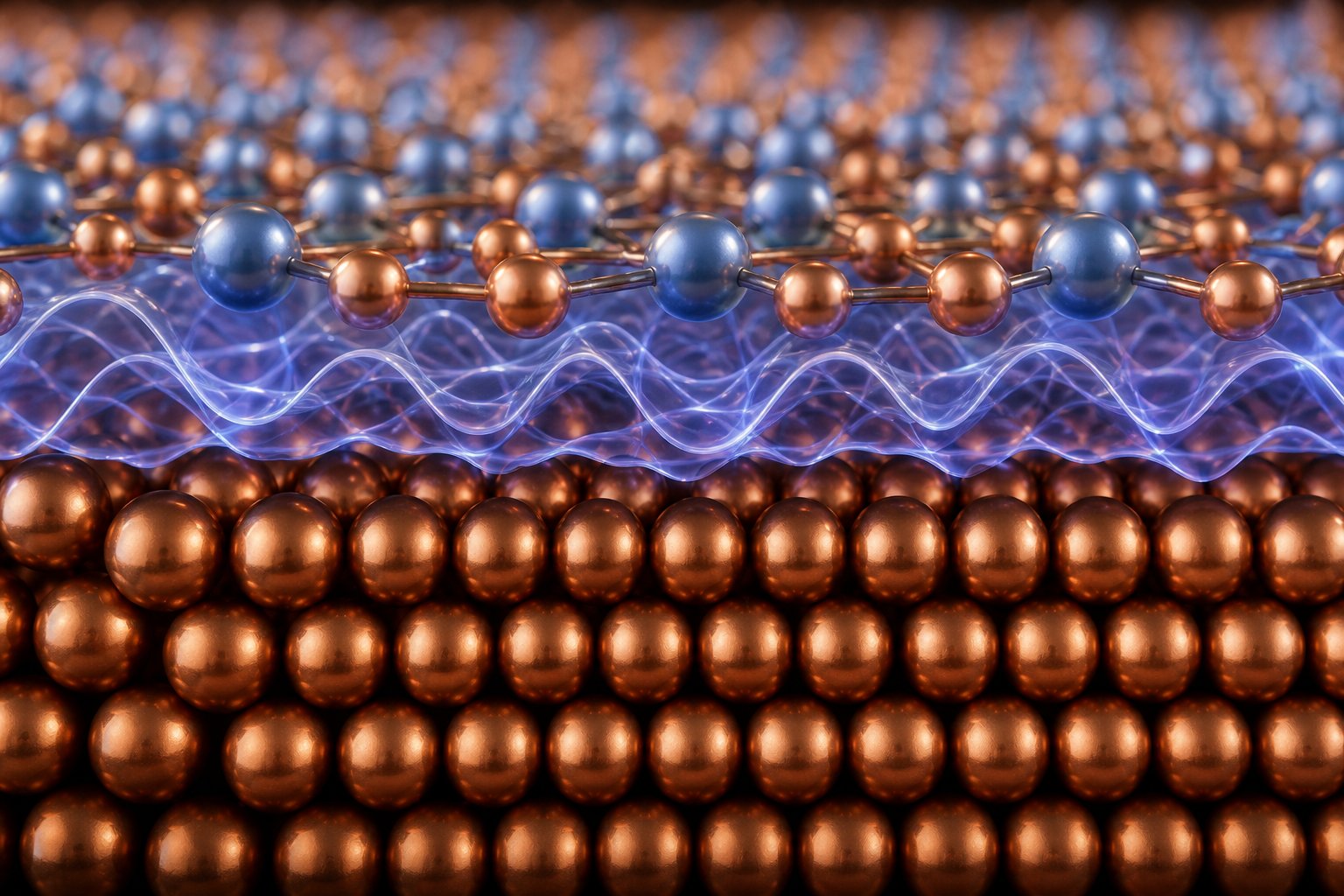
Scientists at the University of Osaka in Japan set out to investigate what happens when a single atomic layer of material is placed on a metal. They created a precisely controlled layer of ytterbium and copper (YbCu2) just one atom thick on the surface of a copper crystal. Using powerful synchrotron light, they examined the electrons at the boundary between the two materials.
Their experiments revealed that electrons confined to the thin atomic layer could interact with the more mobile electrons in the copper below. This produced a phenomenon known as heavy fermion behavior, where electrons act as if they have much greater mass than usual. The team found two distinct heavy fermion states: one limited to the two-dimensional atomic layer, and another extending into the three-dimensional copper substrate.
The second state was especially notable. It provided the first direct evidence that heavy fermion behavior can be generated by interactions across an interface between materials. The researchers traced this effect to the hybridization, or mixing, of localized ytterbium 4f electrons in the atomic layer with mobile conduction electrons in the copper substrate. This shows how combining materials with different electronic properties can create quantum effects not present in either material alone.
Professor Shin-ichi Kimura, senior author on the study, emphasized the importance of producing high-quality materials and precise measurements. The group’s next goal is to engineer and control such heavy-electron states, possibly leading to new quantum states such as unconventional superconductivity.
Why it matters for researchers
This discovery highlights the potential of material interfaces—especially those involving atomically thin layers—for creating quantum states that are not possible in bulk materials. For researchers in materials science and nanotechnology, this opens new directions for designing and manipulating quantum phenomena. The ability to induce and control heavy fermion states at interfaces could have implications for quantum computing, advanced electronics, and the search for unconventional superconductors.
The results suggest that future research may focus on adjusting the structure of these interfaces, controlling which electronic orbitals are involved, and manipulating moiré patterns that occur when atomic lattices overlap. These strategies could allow scientists to fine-tune quantum effects in materials with extremely small dimensions, offering opportunities for startups, new research funding, and industry collaborations focused on next-generation quantum materials.
Where to dig deeper
- Read the full story at ScienceDaily
- Track new papers on nanomaterials with Seamless
- Follow University of Osaka’s publications for updates on quantum interface research
This article summarises public reporting. Facts as reported by sciencedaily.com; read the original for full details.