Original source: therobotreport.com — Can AI agents program industrial robots without training data? Berkeley says yes
UC Berkeley and NVIDIA have released open-source tools that enable teams of AI coding agents to write, simulate, and refine robot programs for industrial robots—without the need for training data. According to therobotreport.com, this agentic approach could change how robots are programmed, tested, and deployed on factory floors.
What happened
Researchers at UC Berkeley, in collaboration with NVIDIA, have developed and released RoboSimStudio, an open-source project designed for agentic AI coding of robotic simulation environments. This toolset allows AI agents to generate code with large language models (LLMs), manage the coding process, run simulations, and refine robot programs through iterative testing.
Traditionally, programming industrial robots has been a time-consuming process. Software teams often wait until the end of the design and fabrication process, when the robot and all related equipment are installed, before they can start coding and troubleshooting. The new agentic tools aim to streamline this workflow by allowing AI agents to handle much of the code generation and refinement in simulation, before deployment.
Ken Goldberg, the William S. Floyd Jr. Distinguished Chair in Engineering at UC Berkeley, emphasized that this represents a fundamental shift. Instead of collecting large datasets and manually tuning behaviors, teams of AI agents can quickly generate, test, and refine robot programs that remain readable and interpretable by human engineers for further tuning and verification.
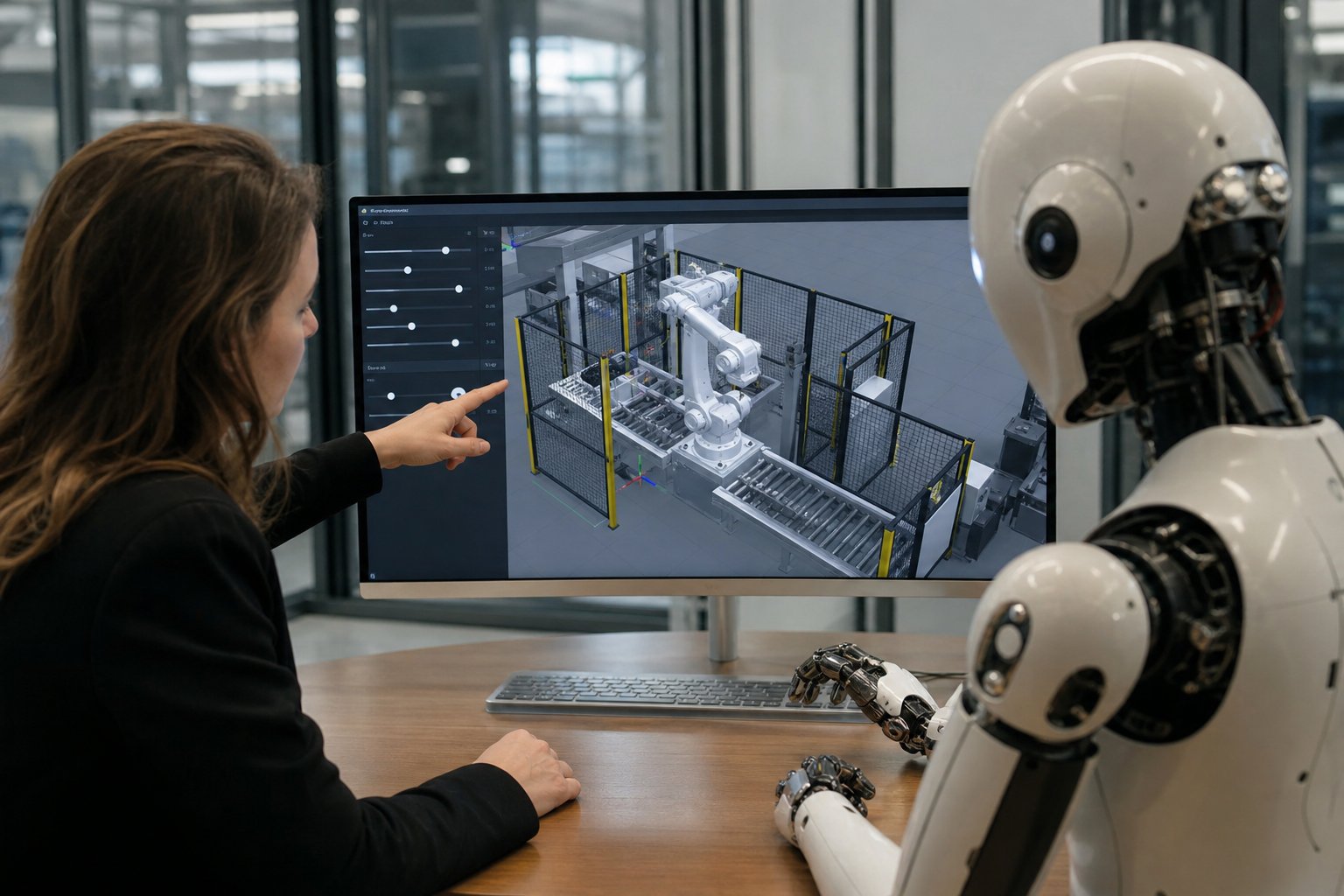
Goldberg highlighted the work of his graduate student, Eric Chen, who developed RoboSimStudio as an easier interface for the Newton Physics engine. Newton is a powerful open-source physics simulator, but its complexity has limited its use. RoboSimStudio simplifies the process with sliders and visualization tools, making it easier for both humans and AI agents to adjust simulation parameters.
In a recent demonstration, Chen gave a video and the RoboSimStudio tool to a new AI model, which produced a detailed Newton simulation of the scene within about an hour. This rapid, iterative simulation is key to the agentic robotics approach, where agents write code, test it in simulation, identify failures, and revise their programs in a feedback loop.
UC Berkeley and NVIDIA also developed the VABAR benchmark suite, which uses the Newton engine and NVIDIA’s Isaac Lab-Arena framework to evaluate robot performance on manipulation tasks. These benchmarks allow researchers to measure and compare progress on realistic industrial tasks with standardized variations and metrics.
Industry partners are taking note. Bosch is evaluating agentic robotics for industrial automation, citing the value of interpretable, engineer-friendly code. Ambi Robotics reported that agentic robotics helped convert production data into robot behavior updates, increasing throughput while keeping engineers in control.
Why it matters for researchers
This development signals a shift in robotics, autonomy, and control research. Agentic AI approaches could greatly reduce the time and expertise needed to program and maintain industrial robots. For researchers, this means new opportunities to focus on high-level system design, optimization, and benchmarking, rather than low-level coding and troubleshooting.
The open-source release of these tools and benchmarks also supports reproducibility and collaboration. As industry demand for flexible, reliable automation grows, skills in agentic robotics, simulation, and AI-driven code generation are likely to be in high demand across both startups and established companies.
Where to dig deeper
- Read the original report on therobotreport.com for detailed interviews and technical insights.
- Explore RoboSimStudio and the VABAR benchmark suite via UC Berkeley and NVIDIA’s open-source repositories.
- Track new papers on robotics with Seamless.
This article summarises public reporting. Facts as reported by therobotreport.com; read the original for full details.